In a nutshell
- 🍋 The lemon’s citric acid and limonene break down oils, soap scum and limescale, delivering a streak-free shine in about 60 seconds.
- ⏱️ A precise, four-part method: dampen cloth with lemon, wipe in an S-pattern, allow a brief micro-dwell, then buff dry with a clean cloth or newspaper.
- 🧽 Tools matter: use a tight-weave microfibre cloth (no fabric softener), minimal moisture, and a second bone-dry cloth to eliminate streaks.
- ⚠️ Safety notes: avoid soaking mirror edges, keep lemon away from unsealed stone, test coated glass, and protect frames; gloves help if skin is sensitive.
- 🔬 Smart swaps: choose lemon for mixed grime, white vinegar for mineral haze, isopropyl alcohol for fingerprints, or commercial cleaners for convenience.
Bathroom mirrors collect mist, toothpaste flecks, limescale and the faint film of aerosol sprays. You wipe, they smear. You buff again, they fog. There is a faster fix hiding in your fruit bowl. A fresh lemon can cut through grime in roughly a minute, because its natural chemistry breaks the bonds that make muck cling. Used smartly, it changes cleaning from a chore into a quick swipe-and-shine ritual. Here’s how it works, why it’s safe for glass, when to use it, and the exact steps to achieve a streak-free finish that rivals pricey cleaners without the harsh smell or the plastic bottle.
Why Lemon Works on Mirror Grime
Lemons earn their keep thanks to citric acid and aromatic compounds like limonene. Citric acid lowers pH, disrupting the mineral salts and fatty residues that bind dust and soap films to glass. In hard-water homes, it helps dissolve limescale, the chalky deposit that adds haze. Limonene, a natural solvent found in the zest, loosens greasy fingerprints and hair-spray overspray that behave like invisible glue.
Grime sticks because of static, oils and microscopic texture. The acid chelates calcium and magnesium, while lemon’s watery juice physically lifts the loosened particles. That is why a quick, controlled dwell time works: give chemistry a brief moment, then wipe. In under a minute, the film weakens; the wipe becomes effort-free instead of elbow-grease heavy. You’re not masking with fragrance; you are changing the surface conditions that made dirt stubborn.
There’s also a practical perk. Lemon leaves a clean, light scent without the heavy odour some commercial products carry. For daily bathroom habits, especially in small British flats without robust extraction fans, a fresh citrus note is simply nicer. And because it’s biodegradable, you avoid smearing synthetic surfactants that can re-attract dust later. Highlight this: the glass is inert; the acid targets deposits, not the mirror itself.
The 60-Second Method, Step by Step
Set a timer. Grab half a lemon, a microfibre cloth (tight weave, 300–350 GSM), and a dry buffing cloth or sheet of plain newspaper. Optional: one drop of washing-up liquid to boost glide if your mirror is heavily sprayed with hair products. Do not soak the mirror; minimal moisture delivers maximum clarity.
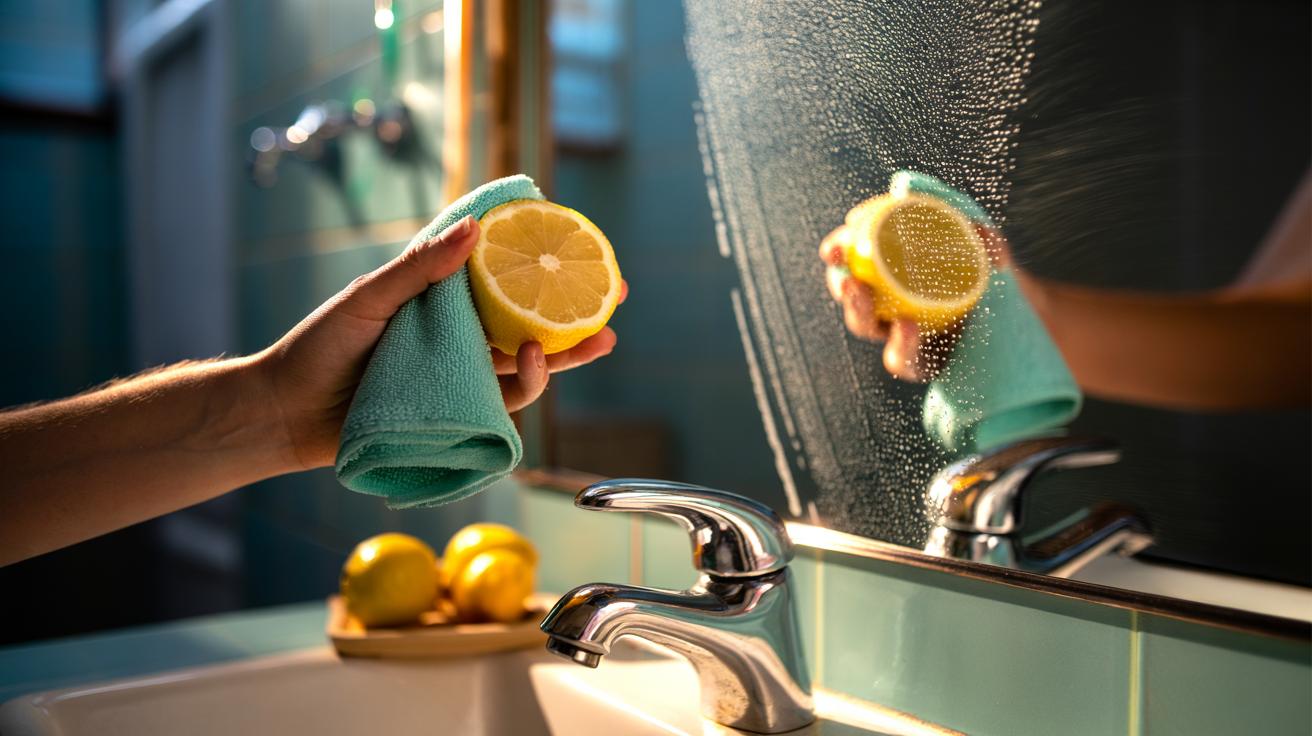
Seconds 0–15: Squeeze the lemon lightly into the cloth, not directly on the glass. You want a damp, not dripping, pad. This stops juice from running to the edges, where prolonged wetness can creep behind the mirror and risk the silvering. If a corner looks especially chalky, press the lemon cut-side to that small patch first.
Seconds 15–30: Wipe the surface in a tight S-pattern from top left to top right, then down a stripe, then back. Keep strokes overlapping. This spreads a thin film of citric acid evenly and starts dissolving soap scum and limescale. If you added a tiny drop of washing-up liquid to the cloth, its surfactants help slice through aerosols without foaming.
Seconds 30–45: Pause. Let chemistry nibble at the grime. Not long—about 10 to 15 seconds. This micro-dwell is the secret to the “60-second” win. In hard-water areas, mist a thimble of distilled water onto the cloth and pass once more to dilute minerals that could streak.
Seconds 45–60: Switch to the dry cloth or newspaper. Buff briskly, again in an S-pattern, until the glass squeaks. Angle your view: if you spot a halo, it’s residue, not scratches. One more dry pass removes it. You should see sharp reflections, no ghosting, and no sticky feel if you run a fingertip lightly across the edge.
Streak-Free Finishing and Safety Notes
Technique matters as much as chemistry. Use light pressure; let the cloth, not your wrist, do the work. Microfibre is engineered to trap particles, so avoid fabric softener when washing cloths—softener greases the fibres and causes smears next time. For an immaculate finish, finish-buff with a separate, bone-dry cloth you keep only for glass. Two-cloth cleaning—one damp, one dry—cuts streak risk to nearly zero.
Mind the perimeter. Mirrors are glass on the front, reflective coating on the back. If liquid consistently pools at the edge, over months it can creep to the silvering. Prevent this by squeezing lemon juice into the cloth rather than sloshing it on the surface, and by keeping strokes horizontal near the top edge. For delicate, anti-fog or tinted coatings, do a 1-inch test in a bottom corner first.
Skin-sensitive? Pop on washing-up gloves; lemon is acidic, after all. Avoid using lemon near unsealed stone—marble, limestone, travertine—as acid etches them. Protect wooden frames with a quick barrier of a dry towel. Ventilate if your bathroom lacks a fan; quick airflow speeds drying and clarity. Finally, be sustainable: zest the peel for baking or freeze it for cocktails, then compost the rest. Low waste, high shine, zero harsh fumes.
Lemon vs Other Cleaners: When to Choose What
While lemon races through mixed grime, it is not your only option. White vinegar excels at mineral haze but lacks the fresh scent and can linger sharply; isopropyl alcohol flashes off fast and is brilliant on fingerprints but can be drying to frames; commercial glass cleaners bring convenience but sometimes leave polymers that attract dust. The smart home keeps a tiny arsenal and picks the right tool for the mess in front of it.
Use the guide below to match cleaner to problem. Choosing well beats scrubbing hard, every time.
| Cleaner | Best For | Avoid On | Pros | Cons |
|---|---|---|---|---|
| Lemon (citric acid) | Mixed grime, limescale flecks, aerosols, odours | Unsealed stone; prolonged edge wetting | Fast, biodegradable, fresh scent | Needs careful moisture control |
| White vinegar | Hard-water haze, mineral spots | Stone surfaces; some sealants | Cheap, effective on minerals | Pungent smell; slower on oils |
| Isopropyl alcohol | Fingerprints, quick sanitising | Painted frames; certain plastics | Rapid evaporation, streak-free | Flammable; drying to materials |
| Commercial glass cleaner | General maintenance, big areas | Rooms with sensitive users | Convenient, consistent | Residue risk; plastic packaging |
If your mirror lives in a very hard-water area, rotate lemon with a distilled-water spray between deep cleans. For salon-level aerosol build-up, add that tiny drop of washing-up liquid to your cloth on lemon days, and reserve alcohol for a final, fast flash-off before guests arrive.
The lemon trick isn’t folklore—it’s chemistry you can smell, see and finish in a minute. When you learn the S-pattern, control moisture, and buff with a clean, dry cloth, the mirror rewards you with crisp reflections and no foggy halo. Small rituals make homes feel calmer and quicker to keep. Will you try the 60-second lemon method this week—and if you do, what’s the toughest mirror mess you want it to tackle first?
Did you like it?4.5/5 (27)