In a nutshell
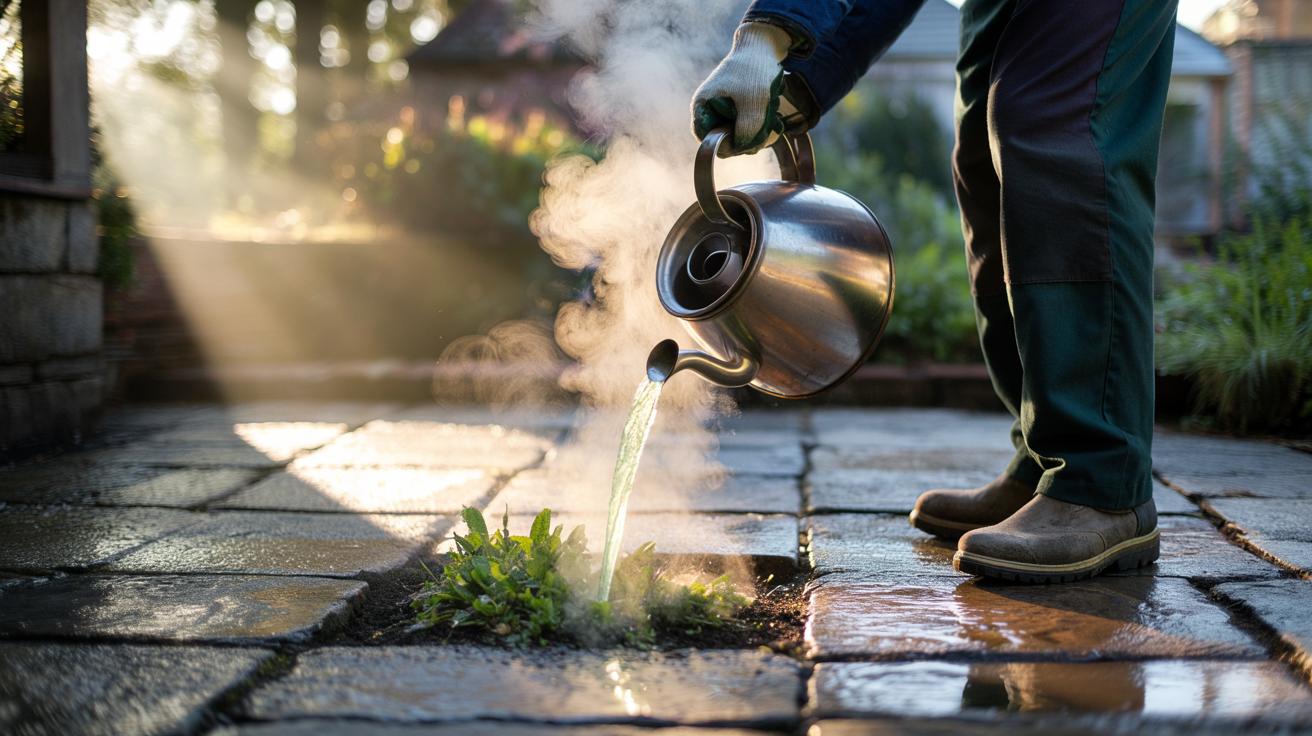
- 🌡️ Boiling water delivers thermal shock that ruptures plant cells, collapsing vascular tissue and causing rapid wilting and browning within 24–48 hours.
- ⏱️ The two-minute method: boil, pour slowly over the crown for 2–3 seconds, repeat for clumps, then leave; two to three rounds a week apart finish shallow-rooted weeds.
- 📍 Best for paving joints, patios, and gravel; effective on seedlings and young rosettes, with no chemical residues and no risk of spray drift.
- 🧰 Prioritise safety and control: gloves, sturdy shoes, a kettle or insulated can with a narrow spout; treat early mornings for hotter contact and fewer splashes.
- ⚠️ Know the limits: deep-rooted perennials may reshoot, avoid lawns unless spot-killing, and protect nearby ornamentals, shallow tree roots, and heat-sensitive surfaces.
It sounds almost too simple: boiling water from a kettle, a careful pour, and unwanted greenery begins to surrender. No sprays. No residues. Just heat. Gardeners report that in as little as two minutes, the most stubborn cracks between paving stones look different—quieter, flattened, stunned. That isn’t magic; it’s thermal shock. The scalding rush ruptures plant cells instantly, breaking membranes and collapsing vascular tissue. This is a rapid, low-cost, glyphosate-free tactic that favours precision over brute force. Used wisely, it turns the weekly weed round into a swift ritual instead of a weekend job. Here’s how the two-minute transformation works, and where it truly excels.
Why Boiling Water Works on Weeds
The science is simple but brutal. Pouring boiling water at 100°C over a weed delivers thermal shock that denatures proteins and disrupts the cell walls that keep stems upright. In pavements and gravel, where roots are shallow and insulated poorly, this heat hits fast. Cell damage begins the moment the plume touches green tissue. The plant’s plumbing—xylem and phloem—collapses, halting water transport. That’s why leaves darken, wrinkle, and slump within hours, with browning often visible by the next day.
Crucially, the method’s effect tails off with soil depth. Heavier soils and deep tap roots, such as dock or dandelion, may reshoot. Yet repeated scalds weaken reserves in the root crown. Unlike systemic herbicides, heat does not rely on active growth phases or dry weather. Rain can follow; it won’t wash heat away. And there’s no chemical drift, a real benefit for small urban plots and wildlife-friendly gardens. The energy is momentary; the impact is decisive.
Because the process is physical, resistance can’t evolve. No clever adaptation helps a leaf keep its proteins intact at 100°C. That makes hot water a neat answer where sprayed weedkillers are restricted, near play areas, or along kerbs where runoff would lead to drains.
Two-Minute Method: Step-by-Step
Time yourself. Kettle on. Gloves on. A metre-square patch of path can be treated in under two minutes, from pour to final sizzle. Speed is the secret to preventing heat loss. As the kettle clicks, walk the route you intend to treat, clearing grit and moving pots. Then work in short, controlled pours, starting at the crown of each weed and spiralling outward to catch every leaf and any seedlings you can see.
Go slowly over the crown. Two to three seconds per plant is enough for annuals in joints and gravel. For clumps, pause and pour a second time after five seconds. Expect a faint steam burst and a “blanching” look as greens lose their sheen. Safety matters: wear boots, keep pets inside, angle the pour away from you. Avoid windy conditions that can flick scalding droplets back towards your legs.
What then? Nothing dramatic. Walk away. The plant looks limp within hours, its colour dulling from bright green to olive. By 24–48 hours, it will be brown and crispy. Pull the remains if you like a tidy finish, or leave them to mulch in a gravel surface. Two to three rounds, a week apart, will usually finish off shallow-rooted invaders.
Where It Shines—and Where It Doesn’t
Boiling water is a star performer on hardstanding. Think block paving, gravel driveways, paths, and patio joints—places where weeds cannot hide roots deep in loam. It’s excellent for seedlings and young rosettes. It also works as a spot-treatment around raised beds, where you’d rather not mist soil with chemicals. Yet it’s less suited to lawns (unless you’re happy to scorch turf) and mixed borders with dense perennials, where a stray splash can scald prized foliage.
Use the table below to match site to method:
| Location/Weed | Recommended Approach | Key Caution |
|---|---|---|
| Paving joints, patios | Slow pour on crowns; repeat in 7 days | Avoid splashing adjacent ornamental leaves |
| Gravel drives | Broad sprinkle, then target larger clumps | Check for plastic membranes that can warp |
| Lawns (isolated weeds) | Only for spot kills; expect turf scorch | Not ideal if you want perfect grass |
| Deep-rooted perennials | Multiple treatments; lift crowns where possible | May reshoot; combine with hand weeding |
Close to trees and shrubs, take care. Although the topsoil cools quickly, repeated scalding directly over shallow feeder roots can stress desirable plants. Avoid porous sleepers, composite decking, and fresh mortar that could crack with thermal shock. Precision is your ally: treat the target and nothing else.
Safety, Tools, and Timing
Hot water is simple, not harmless. Wear long sleeves, sturdy shoes, and heatproof gloves. A cordless kettle or insulated watering can with a narrow rose offers control and reduces splashback. Some gardeners add a short length of copper pipe as a spout to position pours exactly at weed crowns. Keep children and pets away until surfaces cool—usually within minutes on stone, slightly longer on timber or composite decking.
Timing matters. Early morning works brilliantly: cooler air keeps water hotter on contact, and there’s less foot traffic. After rain is fine; damp foliage still scalds. In drought, be cautious on resin-bound surfaces and new tarmac that may soften. For efficiency, treat in zones. Boil, pour, move. Then repeat the circuit with any leftover heat for stubborn clumps. Economy also counts: use only what you need. A litre typically covers a small patio bay or a row of kerb-joint weeds.
Disposal? There’s nothing to dispose of except satisfaction. No bottle, no cap, no label. And because there’s no chemical residue, you can plant in treated areas as soon as they’re cool. The only footprint is the energy used to boil. If you’re chasing lower carbon, consider an induction hob kettle or plan sessions to align with regular tea times.
In two minutes, your patio edges can go from scruffy to subdued, with the rest of the transformation unfolding across the next day. It’s quick, clean, and surprisingly powerful, particularly where weeds thread through stonework. The method won’t conquer every deep-rooted brute, but it excels as a regular, targeted routine that keeps surfaces clear without a chemical crutch. Ready to try the kettle test on your own plot—and if you do, which tricky corner or pathway will you transform first?
Did you like it?4.5/5 (27)